
French artist and critic Joseph Nechvatal just posted in “On Verge” a long, extensive review of Beyond New Media Art, described as “particularly topical and noteworthy, as it is very much in the current inclination to formally re-evaluate contemporary art in terms of a developing post-media understanding.” Mixing appraisal and criticism, Nechvatal offers an insightful reading, connecting the book to more recent developments in the ongoing contemporary art vs new media debate. Check it out!
Beyond New Media Art
Book
Link Editions is proud to announce the release of “Beyond New Media Art”, by Domenico Quaranta.“Beyond New Media Art” is the revised, updated version of a book first published in Italian with the title “Media, New Media, Postmedia” (Postmedia Books, Milan 2010). Through the circulation of excerpts, reviews and interviews, the book produced some debate outside of Italy, which persuaded the author to release, three years later, this English translation.
“Beyond New Media Art” is an attempt to analyze the current positioning of so-called New Media Art in the wider field of contemporary arts, and to explore the historical, sociological and conceptual reasons for its marginal position and under-recognition in recent art history. On the other hand, this book is also an attempt to suggest new critical and curatorial strategies to turn this marginalization into a thing of the past, and to stress the topicality of art addressing the media and the issues of the information age.
From the book’s preface: “So what is New Media Art? What does this term really describe? And what has occasioned the schism between this term and the art scene it is supposed to describe? And lastly, what accounts for the limited presence in critical debate of an artistic practice that appears to have all the credentials for representing an era in which digital media are powerfully reshaping the political, economic, social and cultural organization of the world we live in?”
Link Editions is a publishing initiative of the Link Center for the Arts of the Information Age. Link Editions uses print on demand and digital formats to create an accessible, dynamic series of essays and pamphlets, but also artist books, catalogues and conference proceedings. A keen advocate of the idea that information wants to be free, Link Editions releases its contents free of charge in .pdf format, and on paper at a price accessible to all. Link Editions is a not-for-profit initiative and all its contents are circulated under an Attribution-NonCommercial-ShareAlike 3.0 Unported (CC BY-NC-SA 3.0) license.
Firing a new canon?
Book
I worked on this a couple of years ago, but it’s finally out in printed and digital form. Edited by Valerio Terraroli and published by Bompiani / Skira, It’s an art history book meant for the high schools and universities, from cave paintings to… net art. I made research for the second half of the Vol. 5, on contemporary art from the Fifties to the XXI century, and I was able to add some issues that are not usually featured in high school art history manuals.
Michelle Kuo
Quote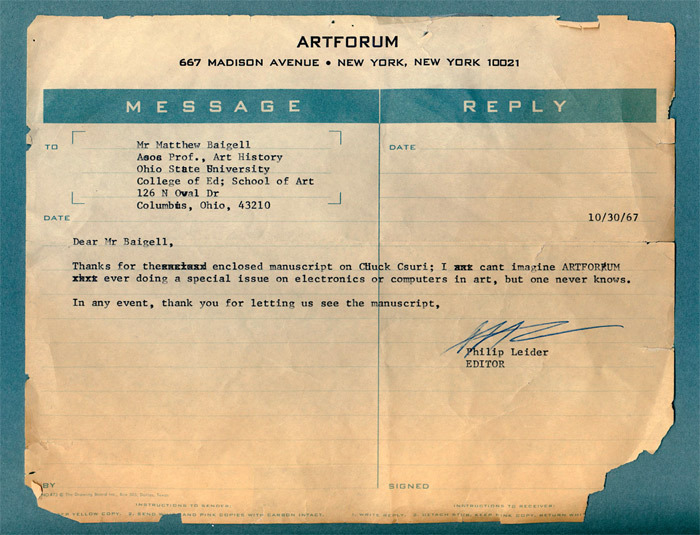
A quote from Michelle Kuo‘s introduction to the September issue of Artforum, “Art’s New Media“:
“Today we still cringe at manufactured genres like “computer art,” even if art as we know it could barely exist without computers. Technophilia and technophobia alike pervade museums, galleries, and art-fair booths; the language of new media and social media—platform, network, algorithm, sharing—abounds in press releases and exhibition titles, slaking our thirst for 1960s-cum-1990s cyber-euphoria. At the same time, Leider’s doubt echoes in the distance, a critical reminder that art’s affair with media is always prone to historical amnesia, to lazy conflations of vastly different positions and practices, to abrupt shifts from the faddish embrace of progress to a pining for the obsolete. We are nostalgic; we want to move on.”
Re: Bishop’s “Digital Divide”
Debate
This is my response to Claire Bishop‘s essay “Digital Divide“, published in Artforum in September 2012 (also posted in the comments section of the article):
Reading this article was a pleasure, and a pain. Some of the points made here are really good, and I also felt a lot of empathy for many of the examples raised, such as the use of obsolete or dead media, or the “archival impulse”, which have been the polar stars of my curatorial and critical work so far.
The problem is that Bishop fails in formulating the main question, that is: contemporary art should respond to the digital age – why it doesn’t? In my opinion, this question should be reformulated this way: “why the mainstream art world, the small niche I belong to and I’m talking to hereby, doesn’t respond to the digital age?”
Marius Watz
BookArt Fag City‘s post on new media acceptation in the art world triggered some interesting responses. This is, for obvious reasons, my favourite one. It was written by artist Marius Watz.
It’s nice to see Arcangel at the Whitney and Ryoji Ikeda at Park Ave Armory before that, but two isolated shows don’t change the fact that this work is barely being shown in the US. And how is Trecartin a “New Media” artist, anyway? Like “Design and the Elastic Mind” before it, MoMA’s “Talk to Me” is great because it exposes the general public to new ideas from technology-based art and design practices. But nowhere will you find the exhibited works described properly within an art context. The V&A in London did a similar sleight-of-hand with their DECODE show, subtitling it “Digital Design Sensations” even though none of the works dealt with design concepts.
Reaction: Art Fag City
Book
Paddy Johnson, “Is New Media Accepted in the Art World? Domenico Quaranta’s Media, New Media, PostMedia”, in Art Fag City, August 30, 2011.
Do institutions and galleries have a growing interest in New Media? Two weeks ago, I identified the art “internet bubble” at The L Magazine, a trend that’s currently giving new media the spot light. Not everyone sees new media the same way though. Domenico Quaranta, an Italian writer and curator previously best known to this blog for “Holy Fire“, a dubiously themed new media exhibition in Brussels that included only “collectible” work, being one such example. Quaranta’s followed up the 2008 exhibition by writing a whole book on the subject of New Media — “Media, New Media, PostMedia” — one core theme being that the field isn’t accepted in the contemporary art world. ”New Media Art is more or less absent in the contemporary art market, as well as in mainstream art magazines,” he writes in his abstract, ”and recent accounts on contemporary art history completely forgot it.” Go on reading…
Gene McHugh
Quote“Contemporary art, to my mind, is in the business of asking “what is contemporary art?”
If contemporary art were pressed to say “contemporary art exists in the digital network as much as it does outside of the digital network,” then contemporary art would all of the sudden be operating from radically different premises.
The “white cube” paradigm (as the site where contemporary art occurs) would be threatened from within.
The “where” of “where the art occurs” would be altered as the simulation of the physical work through (primarily) the Web archive would be understood to be art’s arena.
To my mind, work which successfully bridges the worlds of the digital computer network and contemporary art is work which, on some level, implicates contemporary art into this very network.
It’s not work about the digital computer network, it’s work about contemporary art’s own entanglement in the digital computer network.
And for contemporary art to acknowledge this, it would demand that contemporary art changes the way it sees itself.
As such, contemporary art wouldn’t be taking in an orphan, but a virus.
That’s a lot to ask, but, nonetheless, there’s an urge to start asking.”
In Post Internet, June 1st, 2010
Review: Régine Debatty
BookRégine Debatty, “Book review – Media, New Media, Postmedia“, in We Make Money Not Art, August 27, 2011.
“It’s not every day that i feel like recommending a publication to anyone interested in new media art. No matter the depth of their involvement with new media art, no matter their degree of expertise. Whether you’re a student, an academic and someone who curates or collects contemporary art and is ‘just curious about new media art’, Media, New Media, Postmedia is one book you ought to read. The catch is that, so far, the book is available in italian only. The abstract i butchered above as well as the list of contents are available in english online. It’s not much but it should give you an idea of the breadth and tone of the publication. Media, New Media, Postmedia is a brave book, one that might ruffle a few feathers sometimes (but oh so elegantly!) The publication gives a carefully researched overview of the state of the ‘new media art vs contemporary art world’ debate, navigating deftly between opinions and ideas. As far as i know Media, New Media, Postmedia has no equal in english and i do hope Quaranta looks for and finds a publisher who will be willing to translate it.” Go on reading…
… at ICA, London?
Book
No, it’s not related to the book, but even if the ICA didn’t ask any permission to use the title, I’m pretty honoured that they used it for a talk featuring Professors Lorenz Engell and Bernhard Siegert (IKKM, Bauhaus University Weimar), Boris Groys (New York University) and Éric Alliez (Kingston University). If you are in London on May 26, check it out. And please ask Groys to sign my book 🙂